“AI-powered” usually makes people brace for a bill. With Ariadne’s semantic matching, the honest answer is that most sites will spend less than a cup of coffee a year, and a lot of sites will spend nothing at all. Here’s the actual pricing, the actual per-post cost, and worked numbers for four site sizes so you’re not guessing.
What you’re actually paying for
Ariadne’s Free tier already matches posts on shared tags, shared categories, and title overlap, all computed locally with no external calls. Pro and Pro+ add one more signal on top: semantic embeddings from Voyage AI, which compare posts by what they actually mean rather than which words they share. That’s the piece with a real dollar cost attached, because it’s the one signal that leaves your server.
Ariadne calls Voyage exactly once per post: when you save it, and only if the content actually changed since the last time. Nothing is called while a visitor is reading your site. The bill is tied to how much you write and edit, not how much traffic you get, which is a meaningfully different cost model than most “AI-powered” plugins that either charge a flat monthly SaaS fee or meter by pageview.
The actual rate
Ariadne uses Voyage’s voyage-4 model by default. Voyage prices it at $0.06 per million tokens, and every new Voyage account starts with 200 million tokens free. Each post you send is capped at 8,000 characters, roughly 2,000 tokens, no matter how long the post actually is. That cap is enforced in code, not just documented as a guideline, so a 400-word post and a 4,000-word post cost the same to embed.
Put plainly: at $0.06 per million tokens, embedding one post costs about $0.00012. You’d need to publish or substantially edit roughly 8,000 posts before you spent a single dollar beyond your free allowance.
Four sites, worked out
These numbers assume every post hits the full 2,000-token cap, which is the worst case, not the typical one. Most posts are shorter than 8,000 characters, so real costs tend to land below these figures.
| Site size | One-time backfill | Covered by free tokens? | Ongoing cost |
|---|---|---|---|
| Small (200 posts, ~10/mo) | ~400,000 tokens | ✓ yes | Fraction of a cent/month |
| Established (5,000 posts, ~50/mo) | ~10,000,000 tokens | ✓ yes | Under $0.01/month |
| Large publisher (50,000 posts, ~500/mo) | ~100,000,000 tokens | ✓ yes | ~$0.06/month |
| Very large (200,000+ posts) | 400,000,000+ tokens | Partial, overage applies | ~$12 one-time overage, then cents/month |
Worst-case estimates assuming every post uses the full 8,000-character cap. Billed directly by Voyage AI to your own account, at Voyage’s current published rate.
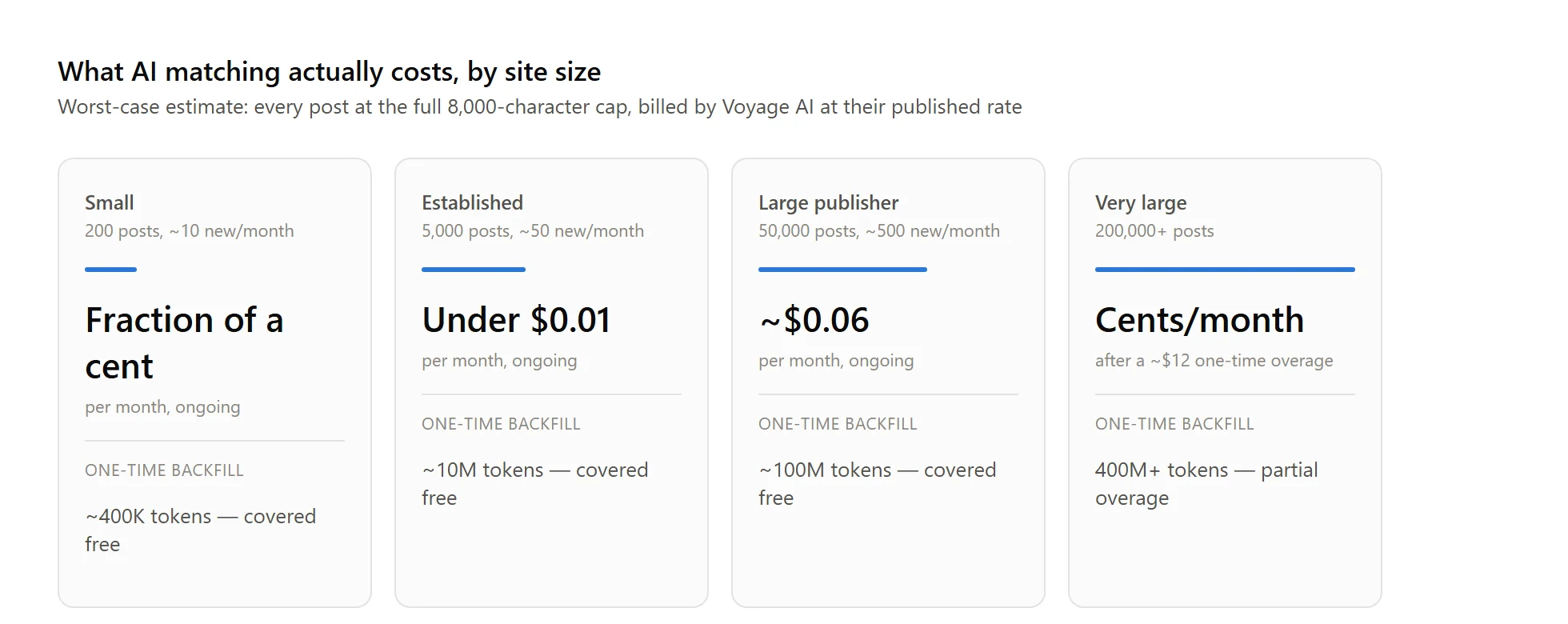
Notice where the line actually falls: a site would need to publish and edit around 200 million tokens’ worth of content, roughly 100,000 full-length posts, before the free allowance runs out. That covers the entire initial backfill for almost any WordPress site that exists today, blog or otherwise. Only the very large publisher tier in that table ever touches real money, and even then it’s a one-time $12, not a recurring charge.
Who actually pays, and to whom
This is worth stating plainly because it’s not how every “AI-powered” WordPress plugin works: Voyage bills your own account directly, using your own API key. Ariadne and Uwawp never see or handle that payment, never mark it up, and never see your content pass through any server we control. If you cancel your Voyage account or run out of budget, Ariadne’s Free-tier signals (tags, categories, title overlap, local text matching) keep working exactly as before. You lose the semantic layer, not the plugin.
When the AI signal is actually worth adding
If your site is well-tagged and posts on the same topic tend to use similar wording, local matching alone already performs well, and there’s a real argument for staying on Free and not touching a Voyage key at all. Semantic matching earns its cost when your content covers the same ground in different phrasing: a post about “reducing server response time” and one about “why your website feels slow” share almost no vocabulary but are clearly the same topic. Tag overlap and keyword matching won’t reliably connect those two. Embeddings will.
If that description doesn’t fit your site, the free 200 million tokens and the $0.06/million rate are good to know, but you may simply never need to spend either.
Watching your real usage instead of trusting the estimate
Every number above is a worst-case estimate built on the 8,000-character cap, and most real posts fall well short of that. You don’t have to take the estimate on faith either way: the Dashboard’s usage chart tracks actual Voyage API call volume over time, so you can watch your real consumption against the free allowance rather than projecting from a table. If your site is smaller or your posts run shorter than the worked examples above assumed, this is where you’ll see that reflected directly, not in a spreadsheet.
Setup itself takes about two minutes once you’re on a Pro or Pro+ plan: get a key from Voyage, add it as a wp-config.php constant or paste it into Settings, save, and let the background jobs backfill your existing archive a few posts at a time. See our full Voyage AI API key documentation for the exact steps.